Who are you?
What industry do you work in?

From first contact resolution (FCR) to Net Promoter Score (NPS), here's how we keep our customer support on track at Jawnt.

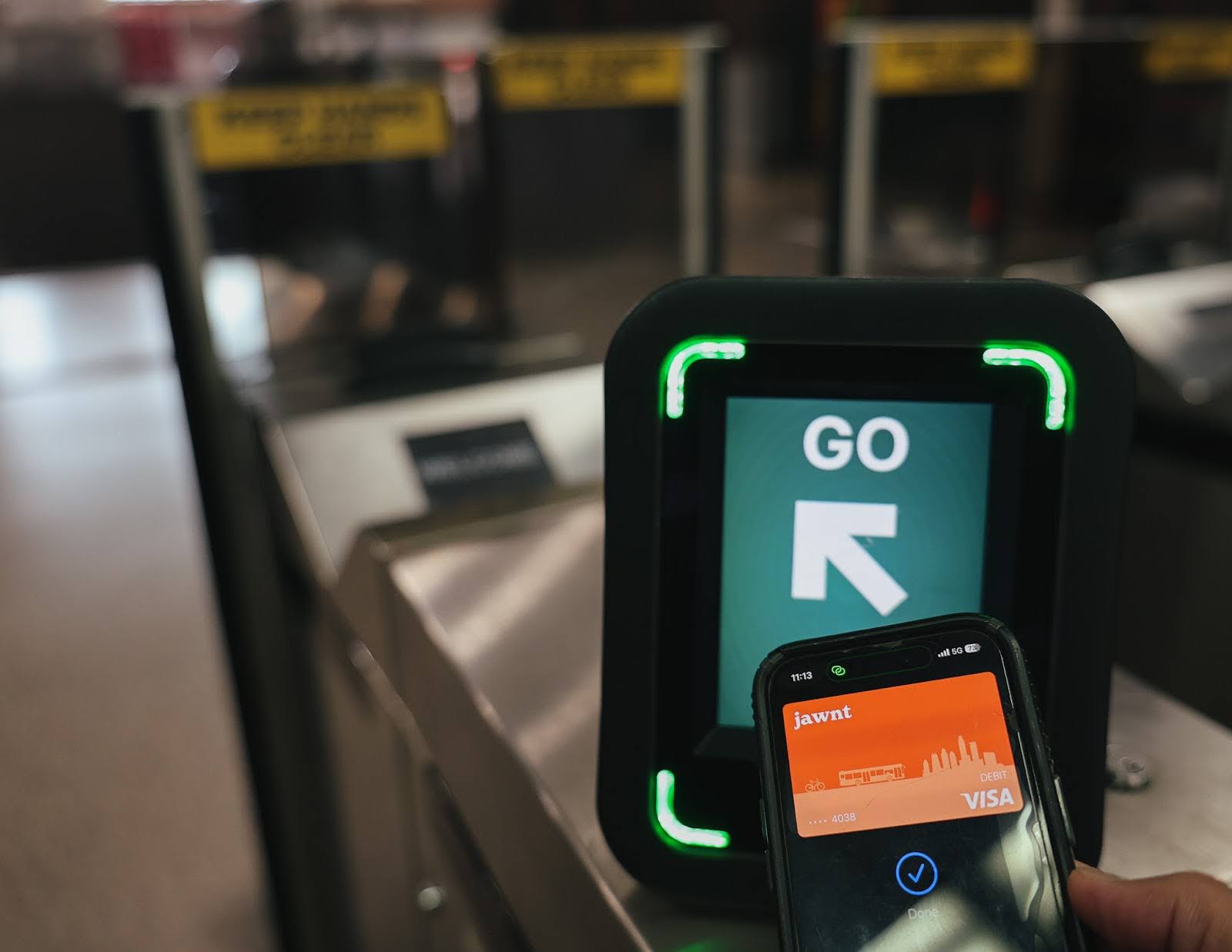
At Jawnt, we are unabashed advocates for real, human support. We know that when it comes to commuting assistance, employees want to speak with someone who understands how transit in their region really works, and who can help them get where they’re going. Because commuting options vary by city, transit agency, and employer, great support in our business requires a team of experienced transportation and benefits experts.
With this in mind, we’re intentional about how we measure customer support, focusing not just on speed, but on effectiveness, empathy, and trust. Below is a look at the key metrics we track to ensure we’re keeping our customers moving.
“Respect time” is one of our core company values. When someone is trying to enroll or troubleshoot their transit pass, a delayed response can result in anything from a missed train to a month without benefits. We earn the trust of our users by respecting their time and responding to inquiries quickly and professionally.
To ensure we’re meeting our high standards of responsiveness, we closely track median response time and median time to resolution for all support conversations, whether it’s by email, chat, or phone.
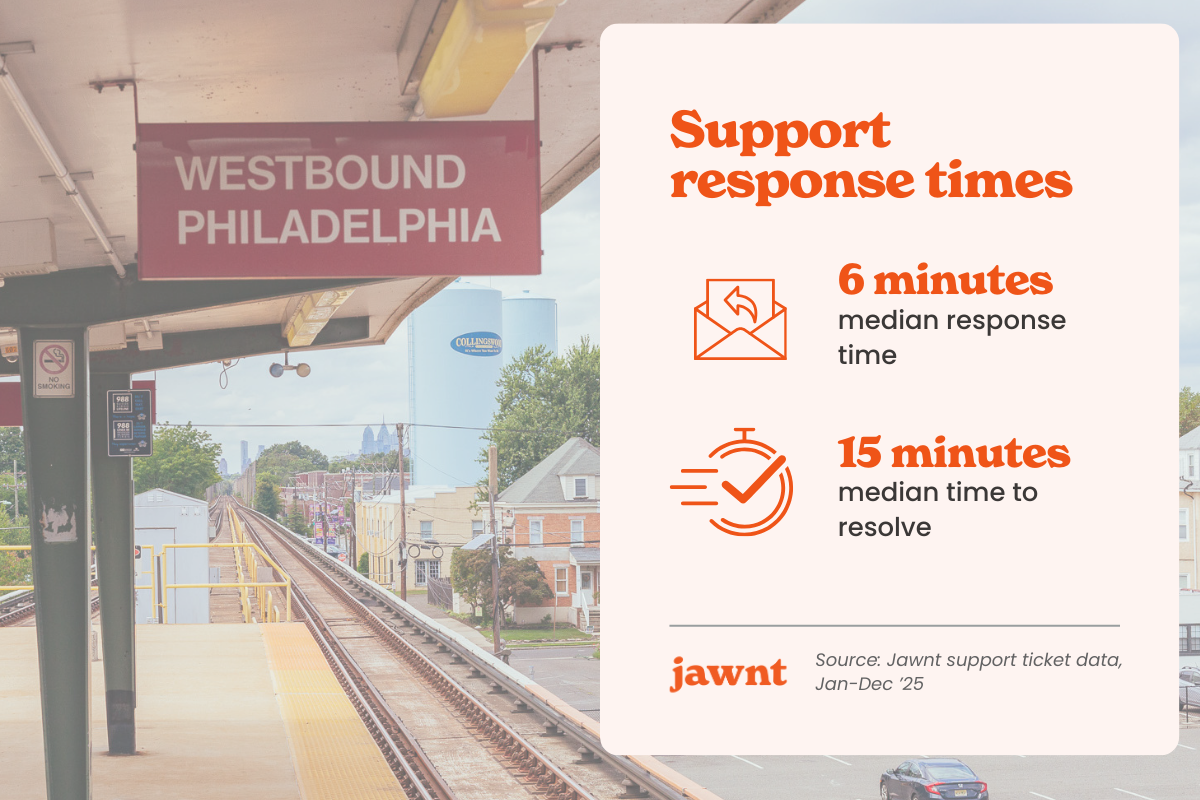
Median response time measures how long it takes for someone to receive a first reply from a human member of our team, whether by email, chat, or phone. We use the median (rather than the average) to avoid skew from outliers and to better reflect the typical experience.
Median time to resolution measures how long it takes for an issue to be fully resolved from start to finish.
Considering that most technology companies measure email response and resolution times in hours, our median response time of 6 minutes and resolution time of 15 minutes rank among the fastest in the industry, and the feedback we receive shows it:
“Thank you so much for responding at such a quick rate. It really helps my commute to be a more comfortable one.”
Resolving issues quickly is only part of the picture. To deliver great support at scale, we also need to understand how and why our customers are reaching out, so we can anticipate needs and adjust our resources proactively.
All support conversations are tagged with one or more topics, allowing us to identify patterns, improve documentation, and refine our product based on our users’ needs.
Here’s a look at the topics that appeared most across all channels in 2025:
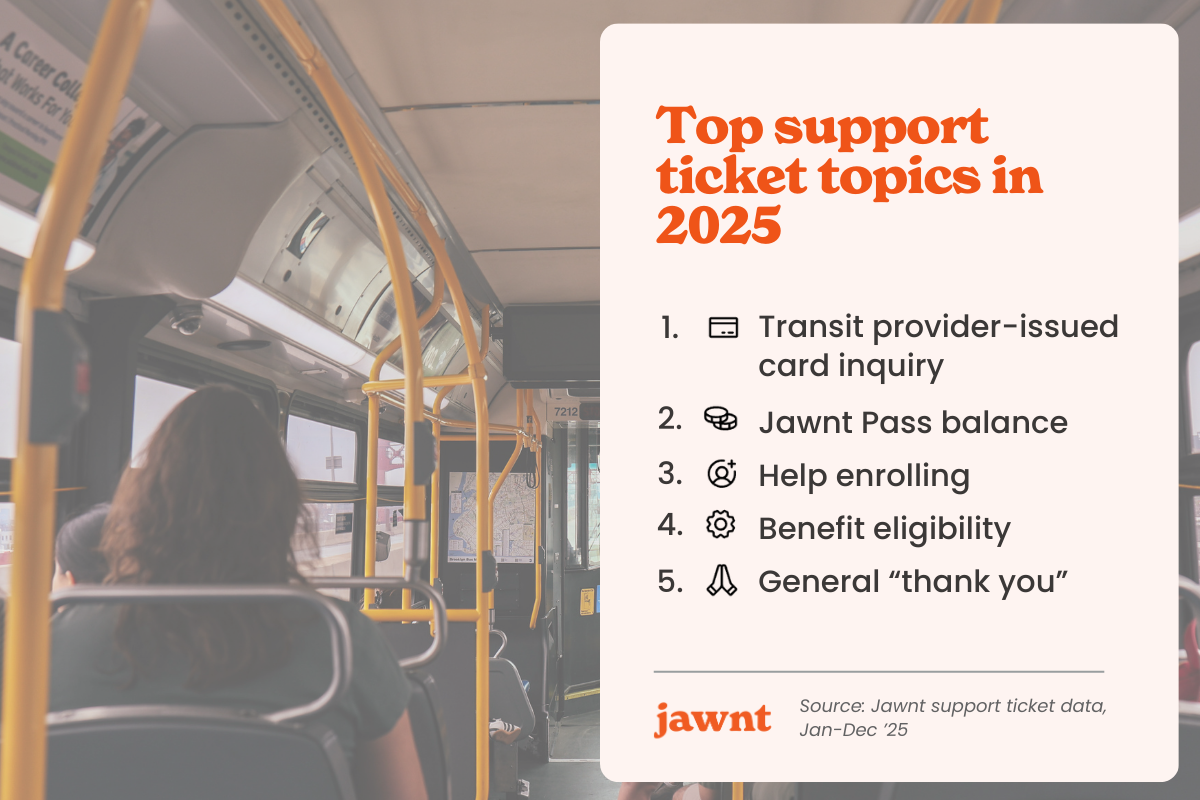
If we slice the data further, we see that email inquiries tend to focus on higher-level questions, such as benefits eligibility or general commuting questions. Chat conversations, on the other hand, are more often tied to enrollment and transactional tasks that can be completed directly in the Jawnt platform, where real-time guidance is especially valuable.
Knowing these are the most common themes we see in the queue, we use this data to ensure our related help articles are up to date and that our team is well versed in handling these requests, including troubleshooting cards issued by local transit providers.
“Sending you this email to inform you I have my key card working. Thank you so much for your help and for contacting me every time I contacted you. You are appreciated.”
One of the best ways to measure support efficiency is by looking at First Contact Resolution (FCR), the percentage of support requests that are resolved in a single interaction. This metric tells us how often our team is able to fully address a question or problem with minimal back-and-forth.
When we measure FCR, we calculate how many requests were closed after response(s) from a single teammate in the same day. Email and chat conversations may include more than one response, but because they are resolved in the same session with the same support agent, they are considered resolved on first contact.
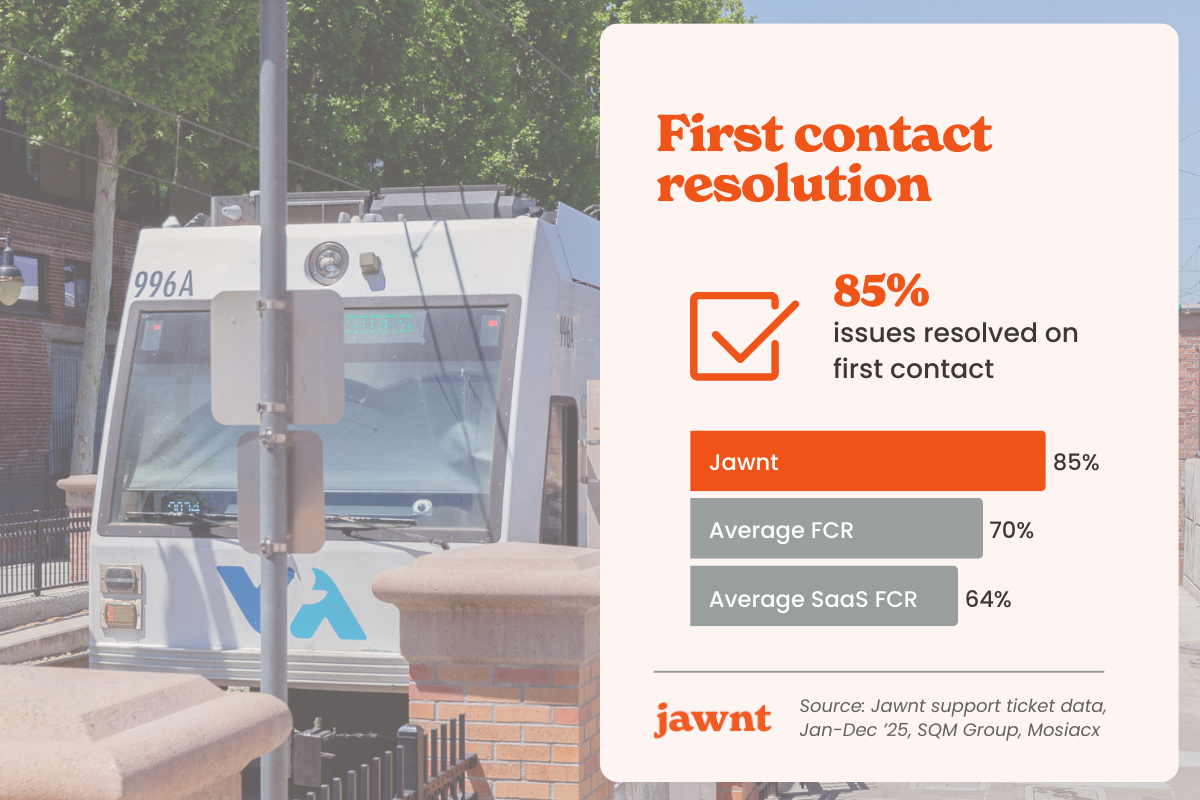
We also examine any trending categories for requests that weren’t resolved on first contact. Some of them, like enrollment questions and Jawnt Pass inquiries, should usually be solvable in one session, so we can use this data to improve our help articles and support tools. However, 42% of these requests revolve around categories like ordering new passes from a transit agency or reimbursements, which are multi-day processes, so we’d expect these to require more than one session.
According to Zendesk, an FCR of 80% or higher is considered world-class, signaling that a support team has the tools, training, and context needed to deliver clear, complete answers right away. For commuters, that means less back-and-forth and more time saved.
“Krista provided excellent customer service and follow-up. She carefully listened, was patient with my questions, provided clear explanations, and followed up to see if she could help. The situation was resolved in a timely manner and I really appreciate her help!”
While operational metrics show us how support performs, customer satisfaction tells us how people feel while interacting with our support team. This is equally important to us, and why we place a high value on our Customer Satisfaction (CSAT) score and Net Promoter Score (NPS).
Customer Satisfaction (CSAT) score is the percentage of support tickets that received a positive rating (in our system, “good” or “amazing”), out of the total number of tickets that received a rating.
Net Promoter Score (NPS) measures how likely users are to recommend Jawnt to others, based on a 0–10 survey rating. The percentage of Detractors (0–6) is subtracted from the percentage of Promoters (9–10) to get the total score.
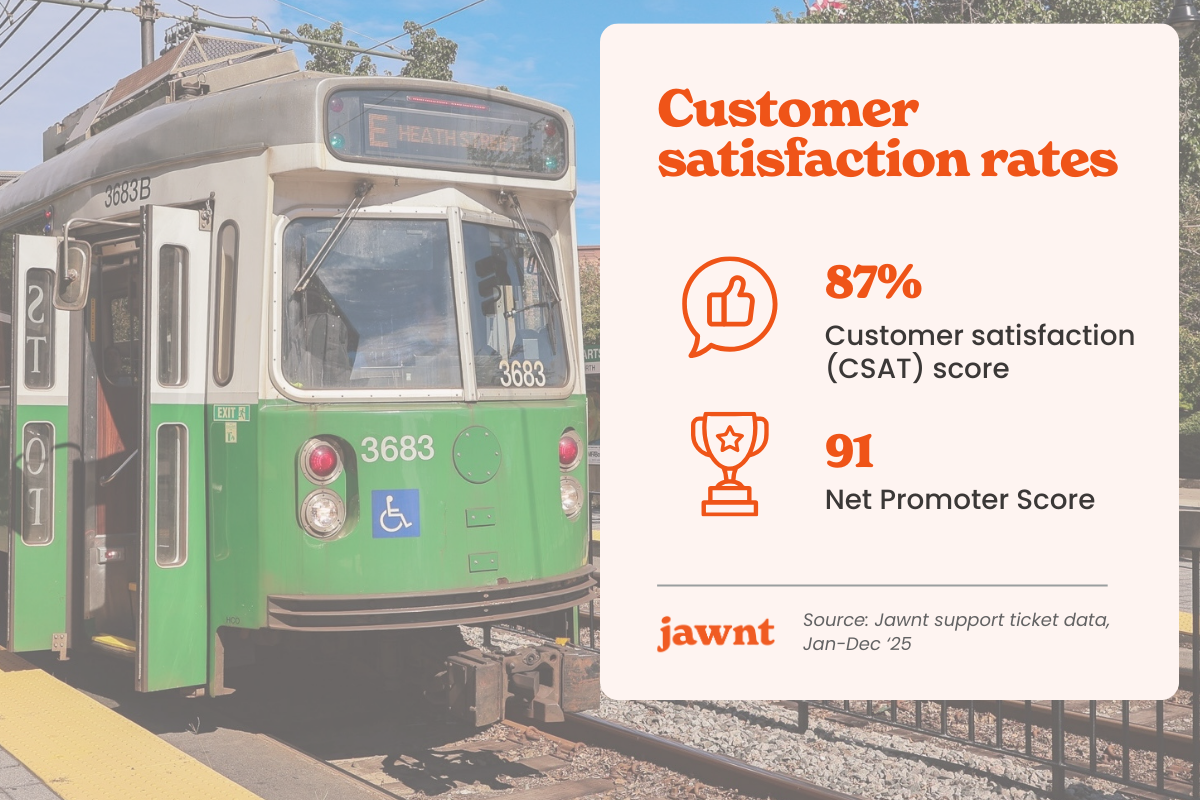
In 2025, Jawnt earned a CSAT score of 87%, falling within the “excellent” range. And in a recent survey, Jawnt earned a Net Promoter Score of 91, which is 55 points higher than the industry average.
We also look closely at qualitative feedback, including direct quotes from support conversations and targeted surveys distributed through employers. Together, these insights give us a fuller picture of how our support shows up for employees:
“You all have the best customer support team around. You're always responsive and courteous!”
“The entire team at Jawnt is so helpful and ultra responsive when the rare issue occurs….I am so grateful for the Jawnt team and platform!”
Since our mission is to make transportation available to everyone, comments like these let us know we’re staying true to our goal and commitment to the customer experience. We’re grateful to each and every user who reaches out to us for help, and of course always appreciate the kind words!
—
Customer support is an integral part of how we operate. By holding ourselves accountable and listening closely, we work to make every interaction efficient, thoughtful, and human. If you don’t currently work with Jawnt but want to learn how we support employees and employers alike, we’d love to hear from you. Get in touch to start the conversation.