Who are you?
What industry do you work in?

An inside look at Harvard's new commuter benefits program, powered by Jawnt.


When the MBTA began transitioning to tap-to-pay technology in 2024, Ben Hammer saw a chance to rethink Harvard's commuter benefits from the ground up.
Hammer, who is the Associate Director of Harvard's Campus Service Center, Parking and CommuterChoice, recognized early on that the university’s commuter benefits infrastructure would need an upgrade to stay ahead of the game.
"The transition to Tap to Ride and digital fare access made it clear that flexibility and multimodal support had to be at the center of our program. It's not just the MBTA that’s evolving, it’s our employees' commuting patterns and expectations as well. We needed a solution that makes it easier and more affordable for the Harvard community to move between modes, adjust their routines, and choose sustainable options, without the complexity or rigidity that can discourage participation."
Ben Hammer, Harvard University
This spring, Harvard is launching a commuter benefits program that expands and modernizes how its employees save money on their commutes. The university’s pre-existing program was already competitive, offering discounted transit passes, a generous bike benefit, a Guaranteed Ride Home program, and personalized commuting support. However, these programs operated largely independent of one another and relied on manual processes, and the distribution and mailing of monthly passes which added administrative complexity and occasional friction for employees.
The new program is a strategic redesign incorporating more flexible benefits, new technology, and a new platform to bring it all together. Below, we break down what launching a modern commuter benefits program looks like in practice, and how Jawnt worked with Harvard to put these innovative new benefits into the hands of its employees.
Expanded transit discounts beyond the monthly pass
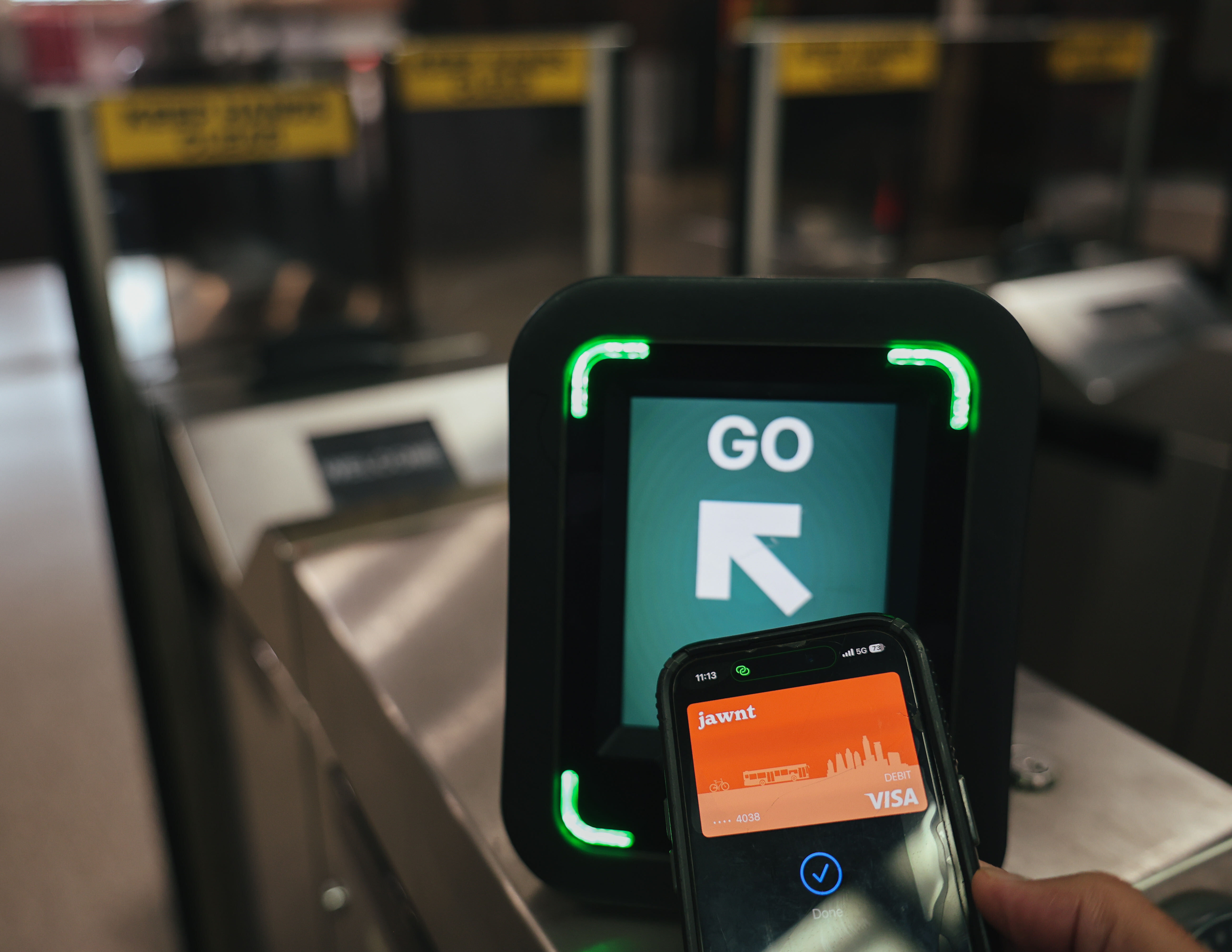
Harvard has offered a subsidy on monthly transit expenses since 2002, but until now, that benefit was limited to monthly MBTA passes. By offering the Jawnt Pass debit card, Harvard now allows employees to apply that same subsidy across a much wider range of transit options for their commuting needs, from regional Amtrak to tap-to-ride on the MBTA, and variable subsidies based on an employee’s unique commute.
Behind the scenes, eligibility rules determine what benefits employees have access to based on their employee type and location. As employees make their elections, Jawnt automatically applies Harvard's 60% subsidy based on their commuting zone, enforces IRS pre-tax limits, and ensures total contributions stay within program limits. Jawnt makes it easy for employees to track their spending or adjust their elections each month. The result is a transit benefit that's sophisticated in its design, but intuitive and transparent for employees.
.JPG)
Seamless support for multi-modal commuters
The new program also supports employees who combine multiple modes of transit. A commuter who drives to a Commuter Rail station, for example, can use their Jawnt Pass to cover both parking and transit costs: they get the 60% transit subsidy applied (based on their commuter zone) when they pay for their Commuter Rail pass, while also benefiting from paying for parking with pre-tax money.
A commuter who bikes most of the year but takes transit during winter can switch their contributions from biking to transit during those months, with just a few clicks in their Jawnt account.
And a commuter who doesn’t commute to campus at all during the summer can pause their enrollment to prevent funds from accruing, then resume their benefit in the fall. Regardless of commuting mode, all purchases—transit, parking, and biking—can be made with a single commuter debit card.
Upgrading the bike benefit from reimbursement to automatic funding
Harvard’s bike benefit got an upgrade, too. Previously, bike commuters had to pay for their expenses up front, then submit reimbursement requests which required submitting receipts and waiting until the end of year for reimbursement.
Now, these employees receive $30 per month loaded directly onto their Jawnt Pass debit card, usable at the point of purchase for bikes, bikeshare memberships, safety gear, repairs, and more. If an employee forgets to pay with their card, they can submit a reimbursement request directly in Jawnt—no more waiting until the end of the year to get paid back.
Not only does the funded debit card simplify the process, it makes biking a more equitable and accessible option, while encouraging commuters to opt for a more sustainable mode of transportation.
.jpg)
The new program doesn't just improve the employee experience, it maximizes how much they can save on commuting costs.
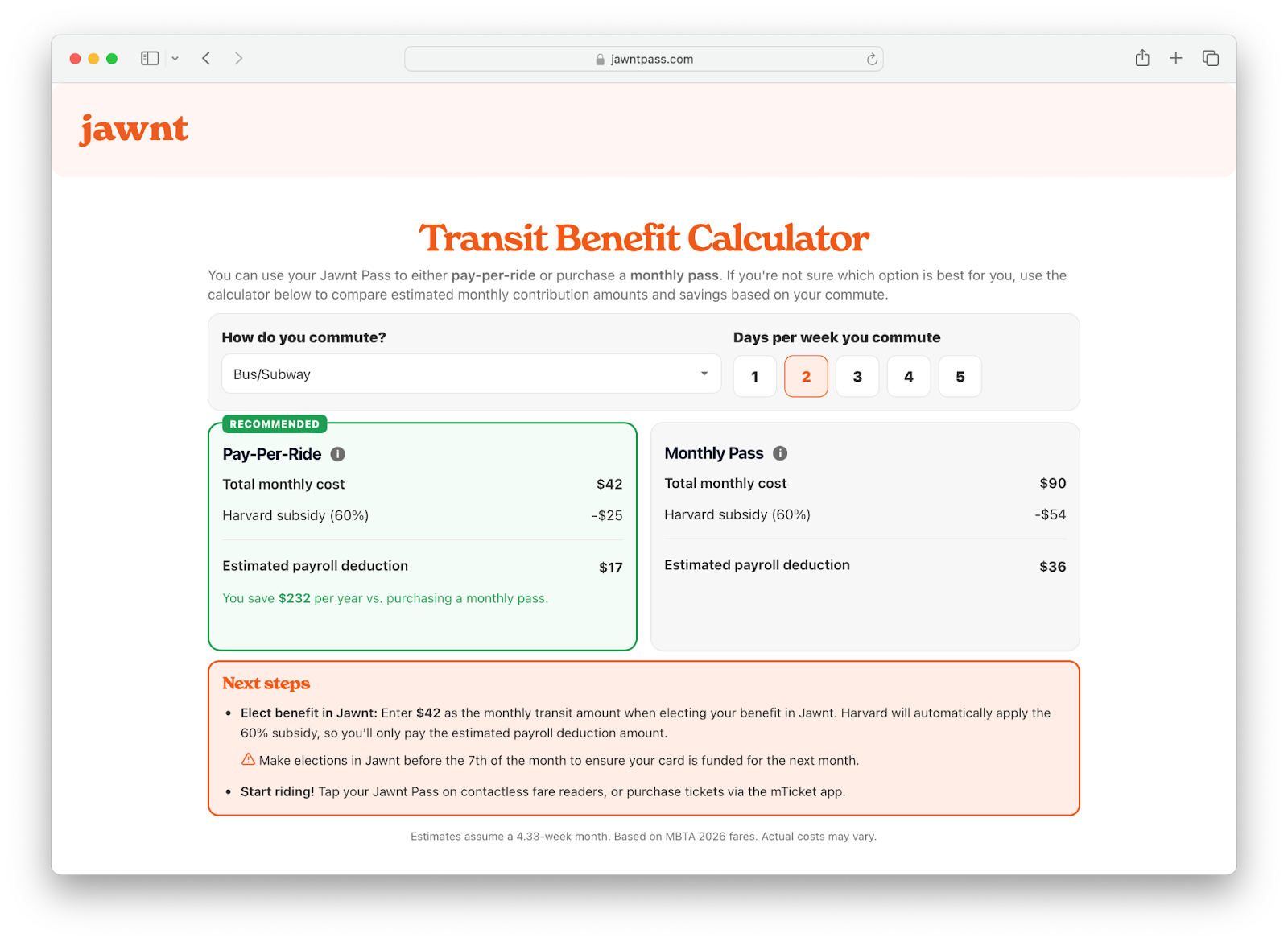
For employees with variable schedules, moving from a monthly pass to a pay-per-ride model means only paying for the trips they actually take. Hybrid workers commuting by subway two days a week only need to load the amount they need onto their Jawnt Pass, instead of paying the full $90 for a monthly pass.

After Harvard’s subsidy is applied, these commuters end up saving $19 a month on out-of-pocket commuting expenses compared to the cost of a monthly pass, which adds up to $232 a year.
Jawnt's easy-to-use commute calculator helps employees estimate these costs and visualize their savings so they can elect the right amount, reducing guesswork and overspend.
Plus: As the MBTA continues to roll out its new technology across all modes of transportation (for example, adding Tap-to-Pay fare readers on Commuter Rail lines), Harvard's Campus Service Center knows that multimodal commutes will only continue to get easier. By introducing Jawnt Pass now, they are positioned to support whatever the MBTA rolls out next, without needing to rebuild their benefits program.
Employees are already seeing the benefits. As one commuter shared after a recent Q&A with Jawnt and the CommuterChoice team:
"After the session, I know that the Jawnt Pass [is different from] my monthly commuter rail pass. I will instead use it to purchase a weekly pass, since I typically commute two times per week. This makes a lot of sense and will save both me and Harvard a considerable amount of money (I'm Zone 8!). I appreciate the efforts that have been made to put this into place."
Building a program of this complexity—across multiple benefit types, compliance requirements, and employee populations—often takes years to plan and roll out. Together with Jawnt, Harvard moved from design to launch in less than a year, with a three-month pilot informing key decisions along the way.
The pilot program, conducted among a small group of transit riders, yielded positive feedback from all participants and gave Harvard stakeholders the data they needed to continue forward.
"This is major. I appreciated being able to use my Apple Watch to tap at the turnstile, in lieu of having to carry my [commuter debit card or MBTA] card and fish that out during my commute. I would pay extra to not have to carry a card around and just use my watch or phone."
Harvard program participant
Jawnt’s flexible platform and communications allowed Harvard to move quickly from pilot to full launch. Harvard partnered with Jawnt to communicate the transition through multiple channels, including targeted email campaigns to employees, virtual office hours and webinars, a comprehensive enrollment guide, and physical mailers to everyone transitioning from the previous commuter benefits provider.
The Harvard team also took a strategic approach to promoting a digitally-oriented benefit to employees with limited workplace access to technology. They partnered with Campus Services units, including Dining Services, to host in-person information sessions and enrollment events. Transportation Services staff brought tablets for on-site registration, along with multilingual support materials, to localized work locations, meeting employees where they were and ensuring broad awareness of the program.
As a result, Harvard saw a 42% enrollment rate across its target audience in the first week alone. Each subsequent email campaign and webinar further boosted enrollment by the hundreds. By anticipating employee questions ahead of time and meeting employees where they were, Harvard converted the majority of their transit benefits-enrolled workforce to a solution better suited to how they actually commute today.
Traditional commuter benefits programs at large institutions are often limited to pre-tax savings or monthly passes, with no changes over time. However, as transit systems, technology, and employee expectations continue to evolve at a rapid pace, Harvard recognized that their benefits should evolve as well. The new commuter benefits program reflects what's possible when an organization embraces this ethos:
"We wanted to build something durable, something flexible enough to adapt over time, but simple enough to deliver meaningful value to our community. If we can make commuting easier, more affordable, and more sustainable for our employees, that’s a meaningful step forward for our employees and the institution."
Ben Hammer, Harvard University
For benefits leaders at other large organizations, Harvard offers a compelling proof point: with the right design and the right partner, commuter benefits can deliver far more than the status quo.
Interested in learning more about how Jawnt can expand your commuter benefits beyond traditional pre-tax and monthly passes? Get in touch with our team.